










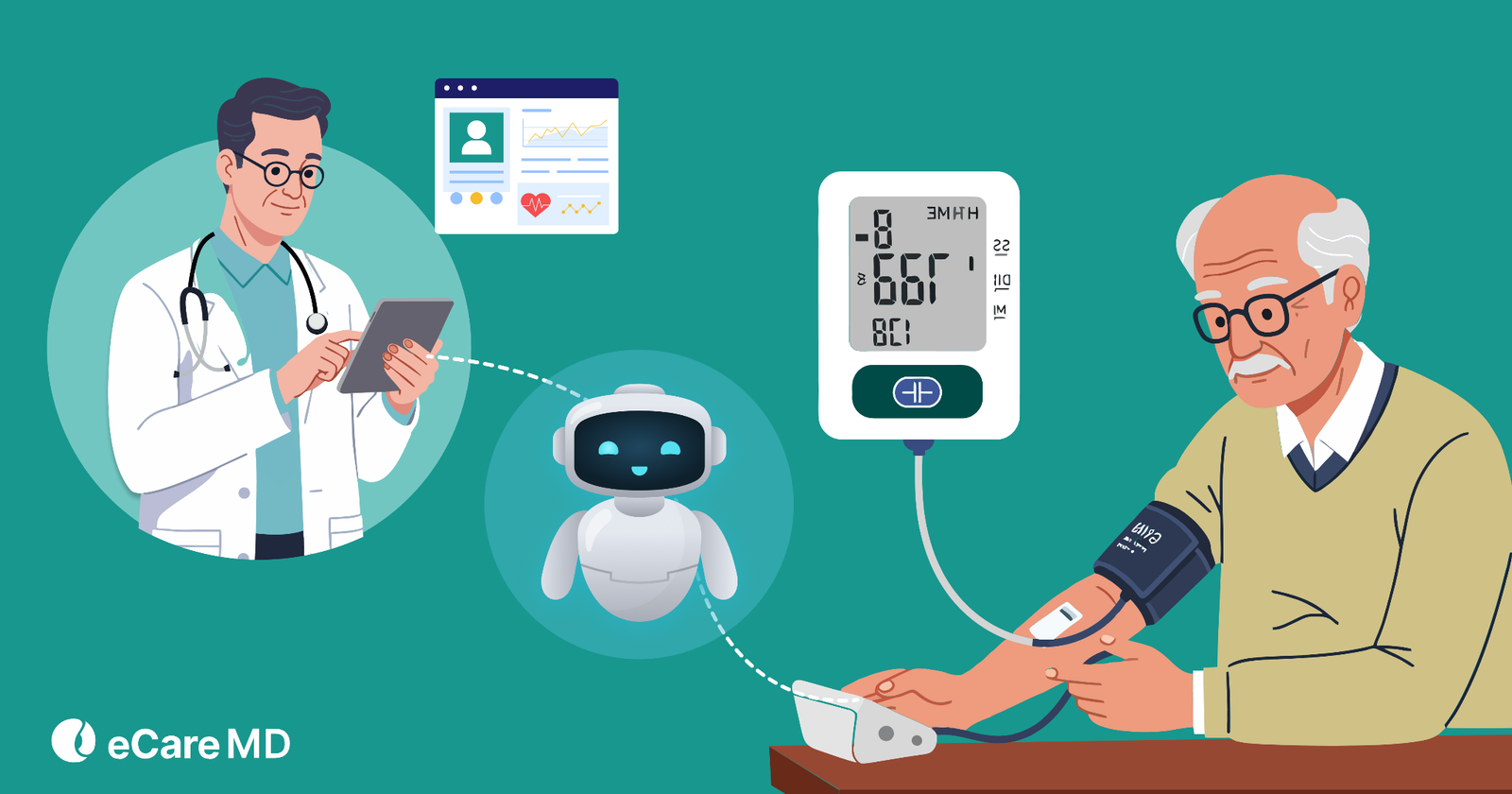
Remote Patient Monitoring (RPM) is becoming a game-changer in U.S. healthcare. In fact, there was a 40.2% increase in the number of hospitals offering RPM services over the 5 years.
Almost all sizes of practices now widely use RPM for tracking vitals like blood pressure, pulse rate, weight, etc. And to boost these uses, Medicare reimbursement under CPT codes 99453, 99454, 99457, and 99458 has made it financially viable.
However, every coin has two sides. Just like that, one major program almost every practice hits once a program gets mature is: Data overload.
Traditional RPM has a reactive approach as it depends on static thresholds, and this is fair enough for small practices. For example, a blood pressure above 140/90 triggers an alert, and a glucose reading above 250 gets flagged.
For a practice managing more than 100 to 200 RPM patients, this can become tricky. It means that dozens of alerts per day, many of which are clinically insignificant.
This is exactly why AI predictive analytics is reshaping RPM, as the next evolution is all about making data work harder. Advanced analytics are reshaping RPM from a passive data-collection tool to a clinical intelligence system.
Let’s dive in to know more about how AI predictive analytics is reshaping RPM.
From Reactive to Predictive RPM
Timing is one of the major limitations in traditional RPM. By the time a static threshold triggers an alert, the patient’s condition has already deteriorated enough to cross that line. A blood pressure spike does not happen in isolation—it is usually the result of a pattern building over days or weeks. Traditional systems cannot see that pattern.
Here, predictive analytics changes the whole equation. Predictive models analyze historical and real-time pattern data, rather than waiting for a critical reading. This further helps to identify risk patterns, vital trends, measurement frequency changes, and daily reading shifts.
For example, a heart failure patient whose daily weight readings show a slow but consistent upward trend over ten days may not trigger a standard alert if no single reading exceeds the threshold. But a predictive model recognizes that pattern as a likely indicator of fluid retention—a precursor to decompensation. The care team gets flagged before the crisis, not during it.
This reactive-to-predictive shift allows clinical intervention, preventing ER visits, reducing hospitalization, and keeping your patients healthier at home.
Role of Machine Learning in RPM
Behind predictive RPM is machine learning, and its real potential lies in personalization. As we know, static clinical rules often apply the same thresholds to every patient. On the other hand, machine learning RPM builds patient-specific baselines based on the patient’s current and historical data.
As clinical norms vary widely, these things matter the most. For example, a resting blood pressure of 120/80 might be perfectly stable for one patient and a red flag for another. With machine learning, you can easily identify these differences and adjust risk assessments accordingly.
Reducing false alerts is one of the key benefits of machine learning, as alert fatigue is a well-documented challenge in the RPM. When you receive too many non-critical notifications, obviously, you start to ignore them. This can ultimately increase the risk of missing something urgent.
However, by machine learning, you can filter out readings within a patient’s established pattern while surfacing meaningful deviations.
These models also continuously learn from new patient data. As more readings come in, baselines become more refined and risk detection improves. This makes machine learning RPM particularly valuable for chronic conditions where patient status shifts gradually and early detection depends on recognizing subtle changes.
Key Use Cases of AI-Driven Remote Monitoring
The practical applications of AI-driven remote monitoring are already taking shape in several high-impact clinical areas.
- Chronic Disease Management:
As chronic conditions like heart failure, diabetes, COPD, etc. require continuous vitals tracking and early detection of exacerbations, AI-driven RPM is the most natural fit.
For example, for your diabetic patient, AI can detect glucose variability patterns suggesting an A1C subtle change before the next lab draw. On the other hand, for a COPD patient, declining oxygen saturation trends can trigger early outreach before an ER visit.
- Post-discharge monitoring:
Another high-value area is post-discharge monitoring. The 30-days after your patient’s hospital discharge is the highest-risk period for readmission, and CMS penalizes hospitals for excessive readmission rates.
With AI, you can track-post discharge vitals and flag early complications, providing your care teams a real opportunity to intervene while the patient is still at home.
- Population health risk stratification:
In population health risk stratification, AI-driven remote monitoring scales beyond individual patients. By identifying high-risk patients early, predictive models can stratify an entire panel by risk level.
This intelligent prioritization approach enables a small care team to manage a large RPM population without sacrificing quality.
Turning Insights into Action with the Right Platform
Predictive analytics is only valuable if it connects to clinical action. If your model easily identifies high-risk patients and then sits in a dashboard nobody checks, it is useless. Platform selection matters as much as the AI itself.
The most effective RPM platforms rely on workflow-integrated systems where AI insights surface directly inside the tools you are already using. When a predictive alert appears within the EHR or care coordination platform, it becomes part of the workflow rather than an extra step.
A platform built around AI predictive analytics reshaping RPM should deliver smart triage and alert prioritization—ranking notifications by clinical risk rather than treating every alert with equal urgency. The patient showing early signs of heart failure decompensation goes to the top; a single slightly elevated blood pressure reading goes further down. This directly reduces alert fatigue.
This also drives scalability and efficiency. Practices relying on manual alert review hit a ceiling fast. A remote health monitoring system powered by predictive intelligence removes that bottleneck, so clinical staff focus on patients who actually need intervention rather than reviewing every data point.
Benefits for Providers
When AI and predictive analytics are properly integrated into an RPM program, the operational and clinical benefits compound.
- Early intervention and fewer hospitalizations: With predictive models, you can catch deterioration earlier, before it becomes acute. This is more beneficial for heart failure and COPD patients, as it reduces emergency visits and hospital readmissions.
- Improved patient engagement: Rather than generic monthly check-ins, your patient can receive proactive outreach based on actual trends. This helps your patients to feel like they are meaningfully monitored, while building trust.
- Reduced clinician workload: Moving forward, with AI, you can also consume your hours of clinical time by handling data sorting, risk stratification, and alert prioritization. It also helps your care team to prioritize high-risk patients, rather than manually reviewing every reading across a large panel.
- Better decision-making with predictive insights: WIth AI, you can easily make informed decisions by what is likely to happen next and not just what already happened. This shifts RPM from a monitoring service to a proactive care delivery model.
Challenges to Consider
AI-powered RPM is not without its hurdles, and practices should go in with realistic expectations.
- Data accuracy and reliability are foundational. Predictive models are only as good as their input data. If patients use devices inconsistently or skip readings, predictions become unreliable. Cellular, plug-and-play devices that minimize patient effort help, but adherence remains a factor.
- Integration with existing systems is a practical hurdle. If AI insights live in a standalone tool disconnected from the EHR, adoption will suffer. The platform must integrate natively with the systems clinicians already use.
- Provider trust in AI takes time. Clinicians are understandably cautious about algorithmic recommendations for patient care. Transparency matters—providers need to understand what the model is flagging and why, not just receive a risk score with no context. Platforms that explain the data behind a prediction earn trust faster than black-box systems.
- Secure, compliant platforms are non-negotiable. Any system processing patient health data must meet HIPAA requirements. As AI models process larger volumes of sensitive data, the compliance bar gets higher—not lower.
Conclusion
AI is transforming RPM from a reactive care model to a proactive care model. With AI, RPM is identifying risk before it becomes a crisis, focusing on high-risk patients, while giving your patients intelligence for managing growing patient panels.
If you are already running an RPM program, the main question you may have is: how quickly can your platform deliver on that capability?
Well, if you integrate AI-driven remote monitoring, it will enhance outcomes, operate efficiently, and thrive under value-based care models.
As RPM has already proved its positive impact on chronic disease management and between-visit care. Now, predictive analytics are turning that impact from incremental into transformational.
Willing to unlock the advanced value of RPM for your practice? Click here to learn more about it.
Frequently Asked Questions
- What is AI predictive analytics RPM reshaping in healthcare?
AI predictive analytics is reshaping RPM by shifting remote monitoring from a reactive, threshold-based system to a proactive model that identifies patient risk patterns early. Instead of alerting providers only after vitals cross a static threshold, predictive models analyze historical and real-time data to flag deterioration trends before they become acute—enabling earlier clinical intervention.
- How does machine learning RPM improve patient monitoring?
Machine learning RPM improves monitoring by building individualized patient baselines rather than applying one-size-fits-all thresholds. It learns each patient’s normal patterns over time, reduces false alerts by filtering clinically insignificant readings, and surfaces meaningful deviations that warrant attention—making monitoring more accurate and less overwhelming for care teams.
- What are the benefits of AI-driven remote monitoring?
Key benefits include earlier detection of clinical deterioration, fewer hospitalizations and ER visits, reduced alert fatigue for clinicians, improved patient engagement through proactive outreach, and the ability to scale RPM programs without proportionally increasing staff. AI-driven remote monitoring helps care teams focus on the patients who need attention most.
- Can predictive analytics reduce hospital readmissions?
Yes. Predictive analytics is particularly effective in the post-discharge period, where it can identify early signs of complications by tracking vitals trends after a hospital stay. By flagging at-risk patients before their condition worsens, care teams can intervene early—reducing 30-day readmission rates, which also helps avoid CMS readmission penalties.
- What challenges exist in implementing AI in RPM programs?
Common challenges include ensuring consistent patient device usage for reliable data input, integrating AI tools with existing EHR and workflow systems, building clinician trust in algorithmic recommendations, and meeting HIPAA compliance and data security requirements for platforms processing large volumes of patient health information.
- How accurate are AI predictions in healthcare monitoring?
Accuracy depends on data quality and model design. AI predictions improve over time as models continuously learn from incoming patient data. The most reliable systems use patient-specific baselines rather than population-level averages, which reduces false positives and increases the clinical relevance of alerts. Consistent device usage and clean data inputs are essential for maintaining accuracy.
- How can AI-powered RPM integrate with workflows?
Effective AI-powered RPM integrates by surfacing predictive alerts and risk scores directly within the EHR or care coordination platform clinicians already use. This avoids creating a separate dashboard that staff must check independently. Workflow-integrated systems ensure that AI insights become part of the clinical decision-making process rather than an afterthought.